

Shan Pereira - Health and Fitness Expert
Shan Pereira is a health and wellness professional committed to supporting individuals in building strong, sustainable fitness habits rooted in evidence-based practice. With a background in exercise science and functional training, Shan focuses on simplifying research-driven strategies into practical guidance that people can apply in real life—whether training at home, in the gym, or integrating movement into busy lifestyles. Through coaching, educational writing, and community-focused engagement, Shan aims to bridge the gap between scientific understanding and everyday wellness decisions. Passionate about empowering people to stay consistent, injury-free, and motivated, Shan contributes actionable fitness insights and balanced perspectives across a range of topics including strength training, home workouts, mobility, and long-term wellbeing.
Table of Contents :
- The Home Cardio Dilemma
- Calorie Burn : Which Workout is Most Efficient?
- Space and Convenience : The Home Factor
- Joint Health : Friend or Foe?
- The Balanced Verdict
- Community Takeaway
- Author
- References
The Home Cardio Dilemma
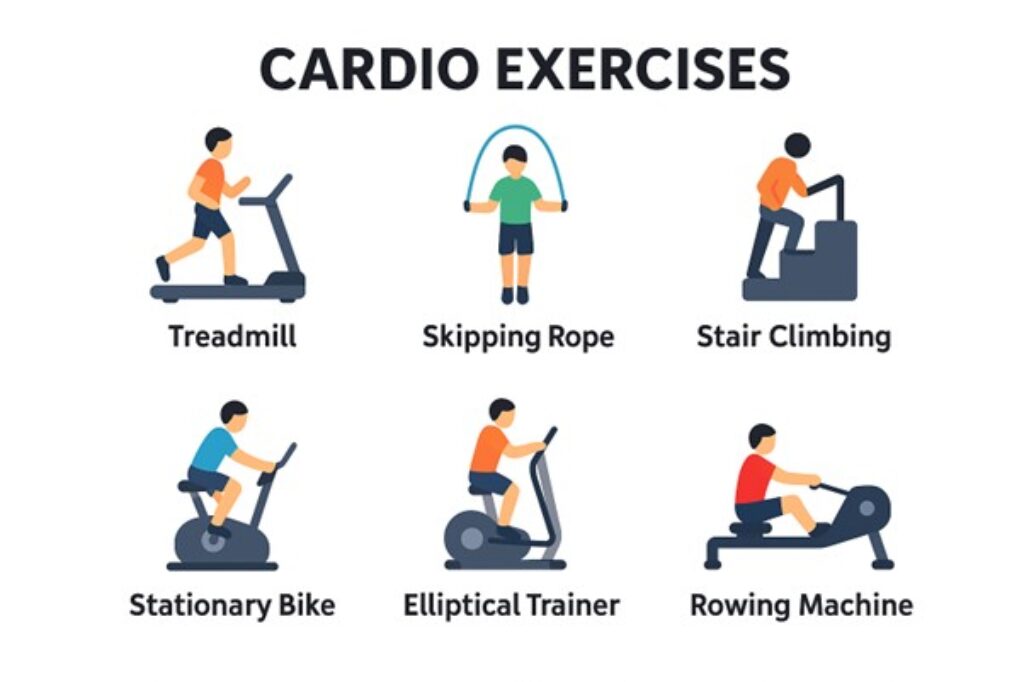
Cardio is the cornerstone of fitness; it boosts heart health, burns calories, and improves endurance. However, when it comes to home workouts, people often face a common dilemma: should I invest in a treadmill, stick to skipping rope, or use the stairs? Each option has unique advantages and trade-offs in calorie burn, space efficiency, and joint health. By examining the science, we can cut through the confusion and determine which method best suits your body and lifestyle.
Calorie Burn: Which Workout is Most Efficient?
When it comes to calorie burning, intensity and body weight play the biggest roles. Research from the Harvard Medical School Exercise Tables suggests the following for a 70-kg individual:
- Skipping Rope: Burns 700–750 calories per hour at moderate pace. One of the most efficient calorie burners.
- Treadmill Running (8 km/h): Burns 600–650 calories per hour. Walking at 5 km/h burns 250–300 calories per hour.
- Stair Climbing: Burns 500–550 calories per hour, with the added benefit of targeting the glutes and thighs.
A randomized trial in the Journal of Sports Science & Medicine found that skipping produced greater improvements in cardiovascular endurance in less time compared to treadmill running. Thus, for calorie burn efficiency, skipping takes the lead.
Space and Convenience: The Home Factor
Not everyone has the luxury of a dedicated workout room. Here’s how the three compare:
- Treadmill: Effective but requires significant space and investment (₹30,000–80,000). Also needs electricity and regular maintenance.
- Skipping Rope: Compact, inexpensive (<₹500), and portable. Can be done in a small area but requires coordination and practice.
- Stair Climbing: Absolutely free and space-efficient, but only possible if you live in a building with stairs, and it may disturb neighbours if done intensively.
From a convenience perspective, skipping rope and stair climbing are clear winners for most Indian households with limited space.
Joint Health: Friend or Foe?
One often overlooked factor in cardio choice is joint impact. High-impact activities can stress knees, hips, and ankles, especially for beginners or those with existing joint issues.
- Treadmill: Running is high-impact, but most modern treadmills have shock absorption, making them gentler than concrete roads. Walking on a treadmill is safe for all ages.
- Skipping Rope: Surprisingly, skipping done correctly (on a wooden or padded surface, with knees slightly bent) exerts less impact than running. However, poor technique or hard surfaces can cause shin splints.
- Stair Climbing: Considered high-load, repetitive stress on knees and hips. While it strengthens leg muscles, it can aggravate knee pain if overdone.
A study in the Clinical Journal of Sports Medicine found that treadmill walking and rope skipping were joint-friendly options for overweight adults, while excessive stair climbing increased knee joint load disproportionately.
The Balanced Verdict
So which cardio is best for you? It depends on your goals and constraints:
- For Maximum Calorie Burn (Weight Loss): Skipping rope is the most time-efficient choice.
- For Joint Safety and All-Age Fitness: Treadmill walking or light jogging offers the safest option.
- For Strength and Endurance in Legs: Stair climbing builds powerful lower-body muscles, but should be moderated for those with knee issues.
The ideal solution? Mix and match. Alternating between these activities keeps workouts engaging, reduces the risk of overuse injuries, and targets different fitness goals.
Community Takeaway
Cardio at home doesn’t need expensive equipment or huge spaces. It requires awareness and consistency. Whether you choose a treadmill, a skipping rope, or the staircase in your building, what matters most is sustainability. The best cardio workout is the one you enjoy enough to do regularly. By aligning your choice with calorie needs, space, and joint health, you can create a personalized routine that works for your lifestyle.
Author :

Shan Pereira – Health and Fitness Expert
Shan Pereira is a health and wellness professional committed to supporting individuals in building strong, sustainable fitness habits rooted in evidence-based practice. With a background in exercise science and functional training, Shan focuses on simplifying research-driven strategies into practical guidance that people can apply in real life—whether training at home, in the gym, or integrating movement into busy lifestyles.
References
1) Harvard Medical School. “Calories burned in 30 minutes of exercise.” Harvard Health Publishing. 2021. 2) Yim-Chiplis PK, et al. “Comparison of jump rope and treadmill exercise training on physical fitness in young adults.” Journal of Sports Science & Medicine. 2019;18(1):55–61. 3) Figueroa A, et al. “Effects of stair climbing vs. treadmill walking on cardiovascular health in adults.” European Journal of Applied Physiology. 2016;116(11-12):2111–2118. 4) Bohn MB, et al. “Biomechanical differences in stair climbing, treadmill walking, and rope skipping: implications for joint loading.” Clinical Journal of Sports Medicine. 2018;28(3):240–246. 5) Garber CE, et al. “Quantity and quality of exercise for developing and maintaining fitness: ACSM position stand.” Medicine & Science in Sports & Exercise. 2011;43(7):1334–1359.